
There is often a pause before someone offers up a piece of information for their typewritten poem. It happens in different ways. At an event, it might look like a guest standing just slightly apart from the rest of the room, watching for a moment longer than necessary. In a quieter setting, it might be someone sitting at a table, hands folded, unsure where to start. Sometimes it comes as a sentence spoken carefully, as if testing whether it can be trusted outside the mind that has been holding it.
Big life moments tend to create this kind of pause. They shift something internally, even when everything on the surface continues as expected. A wedding, a loss, a new beginning, a departure, a return. These moments do not always arrive with clear language. More often, they arrive with feeling first. Language comes later, if it comes at all. It is often here that people turn to poetry. Not because poetry offers answers, but because it makes space for what cannot be easily explained.
The Weight of Moments That Resist Ordinary Language
There are certain experiences that resist everyday speech. You can say, “I am happy,” but it does not always hold the full shape of what happiness feels like when it arrives after a long period of uncertainty. You can say, “I am grieving,” but the word itself can feel too small for the shifting, unpredictable nature of loss. Even joy, when it is deeply felt, can be difficult to articulate without reducing it. In these moments, people are not necessarily searching for more words. They are searching for the right kind of language.
Poetry offers this not by expanding endlessly, but by distilling. It allows emotion to exist without needing to resolve it. It can hold contradiction, complexity, and ambiguity without asking them to become simpler than they are. This is why, during significant life moments, people often reach for poetry without always realizing it. A line remembered from years ago. A poem shared at a ceremony. A few sentences written privately, not intended for anyone else. Poetry becomes a place where the experience can exist without being forced into explanation.

What Happens When Someone Sits Down for a Poem
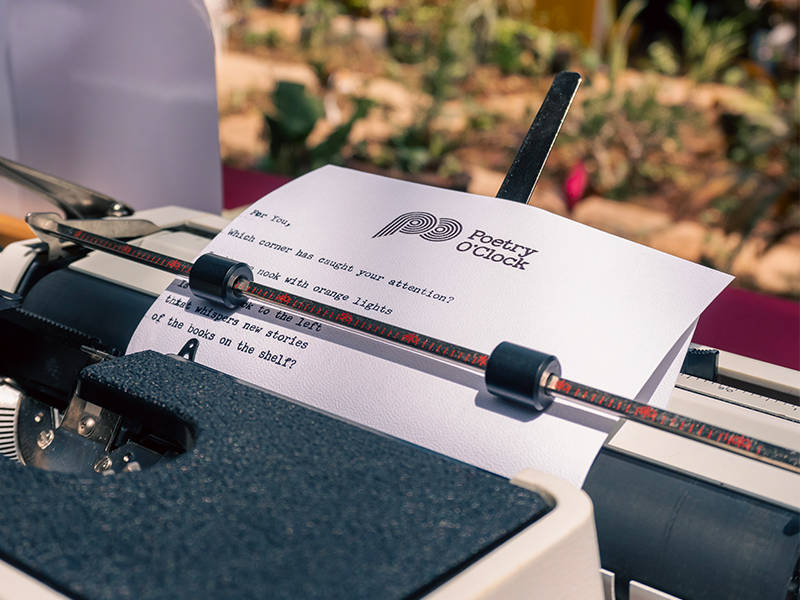
At Poetry O’Clock, this moment is something we witness often.Someone approaches, sometimes with a clear reason, sometimes without one. When asked what they would like the poem to be about, there is usually a brief hesitation. Not because there is nothing to say, but because there is too much, and it has not yet been arranged into something that can be spoken. Then, slowly, it begins.
A story about how two people met, told with small details that might otherwise go unnoticed. A memory of someone who is no longer here, shared carefully, as though speaking their name is itself an act of preservation. A moment of change, described not in terms of certainty, but in terms of feeling. While the typewriter begins to move, there is often a shift in the air. The act of typing creates a kind of quiet that is different from silence. It is attentive. It allows space for the person who has shared something to sit with it, without interruption. When the poem is handed over, there is another pause. This one is different. It is not about searching for words, but about recognizing them.
Recognition, Not Explanation
One of the reasons why people turn to poetry during big life moments is that it offers recognition rather than explanation. Explanation often asks us to make something clear, to organize it, to present it in a way that can be understood quickly. Recognition, on the other hand, allows something to be seen as it is, even if it remains complex. When someone reads a poem that reflects their experience, there is often a moment of stillness. Not because the poem has solved anything, but because it has named something that felt difficult to hold alone.
This is especially true during moments of transition. A wedding, for example, is often described in terms of celebration, but beneath that is a deeper awareness of change. Two lives shifting into a shared space. The presence of family histories, expectations, memories. The awareness that something is both beginning and ending at the same time. A poem written in that moment does not need to explain all of this. It simply needs to hold it, gently and accurately enough that the person reading it feels seen within it.
The Role of Tangibility
There is also something important about the physical nature of poetry in these moments. A typewritten page. A paper that can be held, kept, revisited. In a time where much of communication is immediate and fleeting, the physical presence of a poem creates a different kind of relationship. It becomes an object that carries meaning, not just a message that passes through.
At events, it is common to see people place their poem carefully in an envelope before tucking them away in a bag pocket. Sometimes they read them again before leaving. Sometimes they share them with someone else, watching their reaction closely. Later, these poems often find their way into more permanent spaces. A desk. A wall. A drawer that holds things considered important enough to keep.
During big life moments, people are often aware, even if only subtly, that they want something to hold onto. Poetry, in its physical form, becomes one of those things.
Poetry as a Companion to Memory
Big life moments do not remain fixed. They shift over time, shaped by memory, perspective, and distance. What felt overwhelming at one point may later feel quiet. What once seemed clear may become more complex. Poetry has a particular way of moving alongside these changes. A poem written at a specific moment does not stay contained within that moment. When it is read again later, it often reveals something new. Not because the words have changed, but because the reader has.
This is part of why people return to poetry during significant periods in their lives. It does not demand that they remain the same. It allows for movement, for reinterpretation, for growth. A letter received months ago may carry a different meaning when read again. A poem written during a time of uncertainty may feel like a record of something that has since shifted. In this way, poetry becomes less of a fixed statement and more of a quiet companion.
The Shared and the Private
Another reason people turn to poetry during big life moments is its ability to exist both publicly and privately at the same time. A poem read at a wedding is shared, but it is also deeply personal. A letter received in the mail is private, but it connects the reader to something beyond themselves. A poem written at an event may begin as a conversation, but it becomes something the reader carries alone afterward.
This dual nature allows poetry to meet people where they are. Some moments call for something that can be shared openly, marking an occasion in a way that others can witness. Other moments call for something quieter, something that belongs only to the person experiencing it. Poetry does not require one or the other. It moves between both with ease.
The Practice Behind the Moment
From the outside, poetry during big life moments can appear spontaneous. A poem written on the spot. A letter arriving at the right time. Words that seem to come together effortlessly. But behind this is a practice rooted in attention.Listening closely. Not just to what is said, but to how it is said. Noticing the details that might otherwise be overlooked. Understanding that what someone chooses to share is often only part of what they are holding.
At Poetry O’Clock, this practice is central to everything we do. The typewriter is not just a tool, but a way of slowing down enough to meet each moment with care. Each poem is shaped not only by the words offered, but by the space created around them. This is why the poems resonate. They are not imposed onto a moment. They are drawn from it.
When Words Become a Place to Return To
Big life moments often pass more quickly than expected. A day that has been anticipated for months comes and goes. A conversation that carries significance ends, leaving only memory behind. A transition happens, and life continues, even as something has shifted internally. Poetry does not stop this movement. But it offers something that can be returned to. A page. A few lines. A way of revisiting not just what happened, but how it felt.
This is, perhaps, why people continue to turn to poetry during these times. Not because it captures everything, but because it captures enough. Enough to recognize. Enough to remember. Enough to feel less alone in the experience.
A Quiet Invitation
There are many ways people encounter poetry. Sometimes it is in the middle of an event, in the space between conversations. Sometimes it arrives in the form of a letter, waiting quietly to be opened. Sometimes it begins as a story someone is unsure how to tell, until it finds its way onto the page.
If you are curious about experiencing poetry in this way, you can explore live typewritten poetry at events or receive a monthly letter through The Post: https://poetryoclock.com/the-post/
It is not about having the right words ready. It is simply about allowing a moment to be met with care, and seeing what language might emerge from it.
