
Why creative rituals matter in daily life is a question people looking to liven up the daily life ask themselves. A creative life does not always begin with a major project, a blank canvas or hours set aside for inspiration. Sometimes it begins with something much smaller: writing a few lines in a notebook each morning, reading before bed, keeping a favourite café for quiet afternoons or taking ten minutes to make something with your hands. These small practices can become creative rituals. Over time, they give ordinary parts of the day a sense of intention and familiarity, creating space for self-expression without requiring a particular occasion.
The idea of ritual has been explored in research on routines, relationships and wellbeing. The Greater Good Science Center describes everyday rituals as actions that can take on meaning through the way we perform them and the feelings they evoke. Research discussed by the centre also suggests that engaging in everyday creative activities can be associated with greater positive emotion and flourishing on the following day. That makes creative rituals worth noticing. They offer a simple way to bring creativity into daily life, even when there is no large block of free time available.
What Makes Something a Creative Ritual?
A creative ritual is a repeated activity that gives you an opportunity to notice, make, reflect or express something. The activity itself can be very ordinary, you might write three sentences in a notebook after your morning coffee, sketch while waiting for an appointment, read a poem during your lunch break or collect interesting phrases you hear throughout the week. The creative element’s value comes from the attention you bring to it.
This is part of what separates a creative ritual from simply completing another task. Meaning can develop through repetition where the same notebook, pen, chair or café can become associated with a particular kind of attention. Over time, these details can create a rhythm that feels distinctly yours.
Why Small Creative Habits Can Matter
Daily life is filled with activities that are necessary, useful and often repeated. Creative rituals introduce another quality into that rhythm: intention. A few minutes spent writing can give you somewhere to place a thought before moving on with your day. Reading a poem can change the pace of an evening and making something by hand can give your attention a different direction from the usual demands of work and communication. The point is not to turn every day into a creative project, a creative ritual can remain small enough to fit naturally into the life you already have.
Creativity Becomes Easier to Return To
One of the difficulties with creativity is waiting for the right conditions, you may imagine that you need a free afternoon, a quiet house, a good idea or a particular mood before you can write. Those conditions can be difficult to find consistently but a ritual changes the starting point. When an activity already has a place in your routine, beginning can require less negotiation with yourself.
Perhaps Saturday morning becomes your time to write by hand, Sunday afternoon might be when you visit a favourite bookshop or the last ten minutes before bed belong to reading rather than scrolling. These are modest choices, but they create an expectation that creativity has a place in your week.
Writing Rituals Create Space for Reflection

Writing is particularly suited to ritual because it slows thought down enough for you to see what is actually there. A journal does not need to become a detailed record of every day, you could write about one thing you noticed, one conversation that stayed with you or one question you have been carrying. You could copy out a line from a poem you love or write a letter that you never intend to send, the form can change as your life changes. What matters is having a regular place for your thoughts to meet the page.
This kind of writing can also become a record of time. Months later, you may recognise a version of yourself in an old notebook that you had forgotten was there. The value of the ritual grows partly because the pages accumulate.
Reading Can Become a Creative Ritual Too
Creativity is often associated with making something, but reading can also be an intentional creative practice. Setting aside twenty minutes for a novel, collection of poetry, essay or magazine gives your attention somewhere to settle. Reading can introduce different ideas, voices and ways of seeing the world, while the physical act of returning to a book can become part of a familiar rhythm.
You might keep a book beside your bed, visit a library once a week or choose one poem to read slowly over your morning coffee. There is no requirement to read quickly or finish a certain number of pages, the ritual is in returning.
Rituals Can Give Ordinary Places New Meaning
A creative ritual does not need to happen at home, a café can become the place where you write. A park can become the place where you walk without headphones and notice what is around you. A library can become your Saturday reading space and a particular table can become where you meet a friend for long conversations. The setting begins to carry memories because you return to it with intention.
This is one reason creative rituals can be deeply personal. Two people might perform the same activity in completely different places and attach completely different meanings to it. The ritual becomes part of the relationship between you and your surroundings.
Conversation Can Be a Creative Ritual
Some of the most meaningful creative practices involve another person. A weekly conversation with a friend, an evening spent exchanging questions over dinner or a regular visit to a creative space can become a ritual of connection. There is creativity in paying attention to another person’s stories, remembering details and allowing conversations to develop without rushing towards an outcome.
At Poetry O’Clock, conversation is part of the creative process itself. Live typewritten poetry begins with a brief, attentive exchange where a guest shares a thought, feeling, memory, person or moment, and a poet interprets what they hear into a poem written in real time. Each poem is created once and given as a physical keepsake. The experience shows how simple elements such as sitting together, listening, writing and receiving something on paper can become memorable when they are given time and intention.
Creative Rituals Can Be Shared
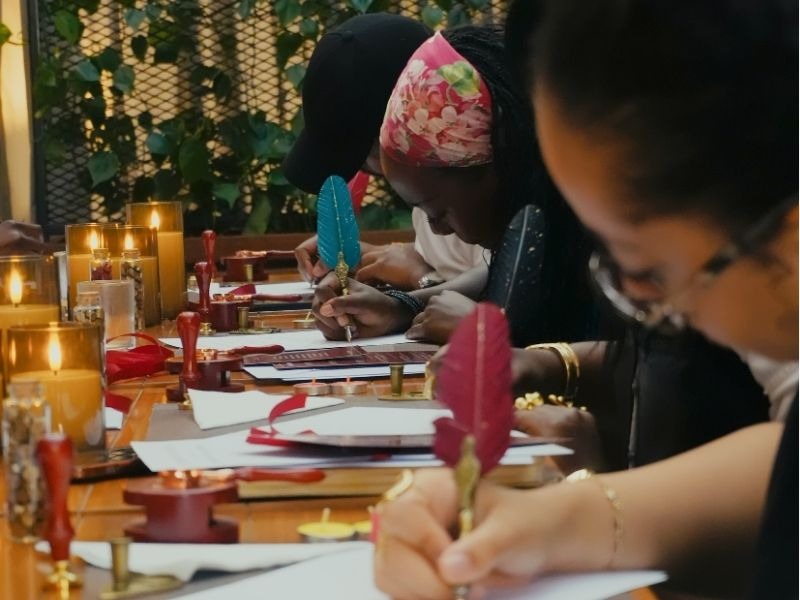
Some rituals belong entirely to you while others become meaningful because someone else is part of them like having a friend you meet every month to exchange books. Shared rituals can create continuity where they give relationships their own small traditions and create memories that do not depend on a major celebration.
Poetry O’Clock’s Table for Two follows this idea through a private 90-minute writing experience for two people, with typewriters, quill pens, paper and prompts prepared at the table. The experience moves between conversation, curiosity and the page before continuing over a meal. The creative activity becomes a reason to spend time together differently, while the materials and setting give the occasion a physical character.
When a Simple Ritual Becomes a Memory
Creative rituals can also shape the way we remember experiences. A handwritten letter becomes connected to the person who wrote it, a notebook carries the marks of many ordinary mornings, a particular café recalls conversations that happened there and a poem can hold the details of a moment that might otherwise have passed quickly.
This is part of the thinking behind Poetry O’Clock’s Keepsake Soirée, where guests write letters by hand, work with feather quill pens, wax seals and stamps, and receive live typewritten poetry shaped from something they choose to share. The experience brings writing, conversation, physical materials and keepsakes into one evening. The ritual matters because the objects carry traces of the experience with them.
Why Creative Rituals Matter in Daily Life
Why creative rituals matter in daily life comes down to something simple: creativity needs somewhere to live. It can live in a notebook beside your bed, in the pages of a book, in a weekly conversation, in the walk you take every Sunday or in the small habit of writing something down before the day gets busy. Creative rituals give these moments a little structure. They make room for attention, self-expression and connection without asking creativity to become another demanding item on a to-do list.
At Poetry O’Clock, we are interested in what happens when familiar acts such as writing, reading, listening and conversation are given enough care to become memorable. A poem typed for you, a page written by your own hand or an afternoon shared across a table can become a physical reminder of a particular moment. Sometimes a creative life is built through large projects. Sometimes it is built through the small things we return to, again and again.
