
Live poetry is the practice of writing a poem for someone in real time, usually during a short conversation and often within the setting of a gathering, celebration, or public event.
Unlike poems written privately and revised over days or weeks, live poems emerge in the presence of another person. A guest shares a memory, a feeling, a name, or a small piece of context. From that brief exchange, the poet begins writing. Within a few minutes, a poem exists where there was none before. That immediacy is what gives live poetry its distinct character.
For many people, the experience feels unusual at first. We are used to encountering poems after they have already been completed, published, and passed through time. Live poetry unfolds differently. It happens in front of you. The poem comes into existence in the same moment you are experiencing it. The guest leaves with the poem in hand, often typed on paper or written in ink, a physical piece of writing created specifically for them and no one else.
Live poetry at a glance
| Aspect | What it usually looks like |
| Starting point | A short conversation with the guest |
| Common prompt | A memory, person, feeling, or occasion |
| Writing time | Usually a few minutes |
| Format | Often typewritten or handwritten on paper |
| What makes it different | The poem is created live, in response to one person and one moment |
| What the guest leaves with | A physical poem they can keep |
How live poetry works
At most live poetry events, the interaction begins with a simple question. The poet asks what the poem should be about. Sometimes the answer is light. A guest may ask for a poem about friendship, travel, a partner, or the atmosphere of the evening. At other times the response carries more emotional weight. Someone may mention a grandparent, a season of grief, a reunion, a beginning, or a feeling they have not yet fully named.
The exchange is usually brief. It is not meant to be an interview or a deep unpacking of someone’s life. The goal is simply to gather enough of the emotional and imaginative material to begin writing. From there, the poet composes.
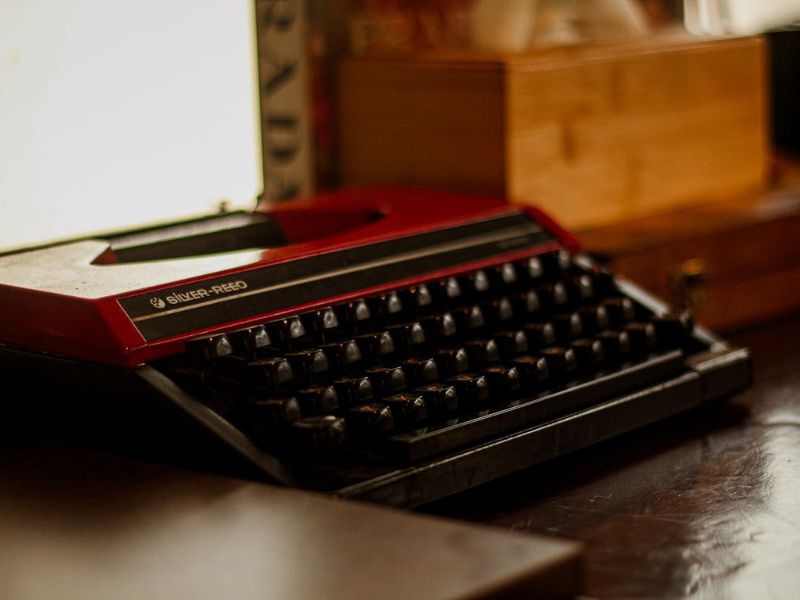
Many live poets work on typewriters, which adds another dimension to the experience. The sound of the keys, the movement of the carriage, and the visible pace of the writing turn the act of composition into part of the event itself. Guests do not only receive the poem at the end. They witness it taking shape line by line. In many cases, the full interaction lasts somewhere between three and five minutes. What remains is the written piece itself.
What the poet is actually listening for
Although live poetry can appear spontaneous from the outside, it relies heavily on attention. A poet is not only hearing the words a guest speaks. They are also listening for tone, pauses, emphasis, tenderness, hesitation, and emotional weight. A single sentence can suggest far more than it first appears to contain.
Someone might simply say: Write about my grandmother. Within that short request, several possibilities are already present. Is the poem about memory, absence, gratitude, inheritance, or longing. Is the feeling warm and celebratory, or quiet and aching. Is the guest asking to honour someone living, someone lost, or someone they miss in a more complicated way.
Live poetry is often less about inventing something from nothing and more about recognizing what is already present in the conversation. The poet’s task is to notice the emotional centre of what has been shared and translate it into language that feels whole.
Why people are drawn to live poetry
Part of the appeal of live poetry lies in its deeply personal nature. Most poems we encounter in daily life were written for a broad audience. A reader may feel understood by them, and may even carry them for years, but the poem itself was not written with that one reader in mind.
A live poem changes that relationship. The poem belongs to the moment and to the person who inspired it. Even if its theme is universal, the path that led to it is specific. It emerged from this exchange, with this guest, in this setting, at this exact time.
There is also something quietly moving about witnessing creation as it happens. Watching a poem being written reminds people that poetry is not only something found in anthologies or classrooms. It is a living practice. It can begin with a conversation, a question, or a pause long enough for someone to say what they mean.
For many guests, the experience also becomes memorable because it produces something tangible. Unlike a passing remark or a digital message, a live poem often exists as an object. It can be folded into a wallet, tucked into a book, placed inside a journal, or kept among letters and keepsakes. Over time, the poem becomes not only a text, but a record of a particular moment in life.
The atmosphere around a live poem
Live poetry can appear in many different settings:
- weddings
- private celebrations
- cultural festivals
- literary gatherings
- hospitality spaces
- brand and corporate events
The setting may change, but certain qualities tend to remain. The interaction is often quiet and focused. Even when the event itself is lively, the small space where the poem is written becomes a kind of pause within the larger atmosphere. A guest sits down. A few words are exchanged. The poet writes. For a brief moment, the surrounding noise seems to soften.
That pause matters. It allows the encounter to feel intimate without needing to become dramatic. It gives the guest time to consider what they want the poem to hold. It gives the poet time to notice what is most alive in what has been shared. When the poem is finished, the guest returns to the wider event carrying something they did not have before. Not simply paper, but language shaped from their own moment.
A practice with older roots than it first appears
Although live poetry often feels contemporary, the idea behind it is much older. Across many cultures, poetry has long been created in response to people, gatherings, and shared experiences. Oral poetry traditions, praise poetry, ceremonial verse, and improvised performance all reflect forms of poetry that emerge in the presence of others rather than in isolation. In many of these traditions, the poem is shaped by immediacy, audience, occasion, and human exchange.
Modern live poetry carries that spirit forward while adapting it to new environments. Typewriters, handwritten cards, and poetry tables make the practice legible within contemporary events, especially for audiences who may not otherwise encounter poetry in daily life. Yet the central idea remains familiar and enduring: poetry arising directly from encounter.
When a poem becomes more than a novelty
One of the most striking things about live poetry is how quickly a brief interaction can turn into something meaningful. A guest may sit down expecting something light, curious, or entertaining. Yet many leave with the feeling that something personal has been recognized and given shape. The experience becomes memorable not because the poem is perfect, but because it is immediate.
In truth, live poems are rarely polished in the way published poems are. They are written quickly. They do not have the benefit of long revision or distance. Their value lies elsewhere. They carry the atmosphere of the moment in which they were made.
That is often what people respond to most strongly. The poem feels alive to its occasion. It holds the energy of the exchange that produced it. Years later, someone may unfold the page again and remember not only the words, but the event, the conversation, the room, the version of themselves who sat down to ask. In that sense, the poem becomes more than writing. It becomes a small record of lived experience.
Why live poetry still matters now
For many people, poetry can feel distant. It is often associated with books, academic study, or a kind of artistic seriousness that seems separate from everyday life. Live poetry quietly challenges that idea.
It reminds us that poetry can also be conversational, accessible, responsive, and present in ordinary human settings. A poem can emerge from a quick exchange at a table. It can begin with a memory shared between strangers. It can arise from a guest trying to honour someone, remember something, or simply hold onto the feeling of a day.
This matters because so much of contemporary life encourages speed. Live poetry does the opposite. It asks for attention. It creates a pause. It treats language as something worth shaping carefully, even in a matter of minutes.
That may be why the experience stays with people. A poem that did not exist earlier in the day now belongs to them. It came into being because they sat down, shared something small but true, and someone listened closely enough to turn it into words. In that brief exchange, poetry becomes something lived rather than merely read.
What makes live poetry distinct
To put it simply, live poetry is not only about the finished poem. It is about the conditions in which the poem comes into being. What makes it distinctive is the combination of:
- real-time creation
- close listening
- personal context
- physical delivery
- emotional immediacy
The poem is not separate from the encounter. The encounter is part of the poem. That is why live poetry often lingers in memory. People do not only remember the lines. They remember being seen, being listened to, and being given language that had not existed for them before that moment.
Closing reflection
Live poetry reminds us that poems do not only belong to bookshelves, journals, or distant literary traditions. They can also belong to tables, gatherings, conversations, and ordinary human encounters that become meaningful because someone paused long enough to notice them.
A live poem may take only a few minutes to write, yet it can stay with someone for years.If you would like to experience live poetry or learn more about the Poetry O’Clock practice, you can explore it here: poetryoclock.com
