
A quiet exchange between strangers, and the words that remain long after
There is often a moment, just before a poem begins, that goes unnoticed by most people in the room. It happens at the edge of the event, slightly removed from the music, the conversations, the movement of people arriving and leaving.
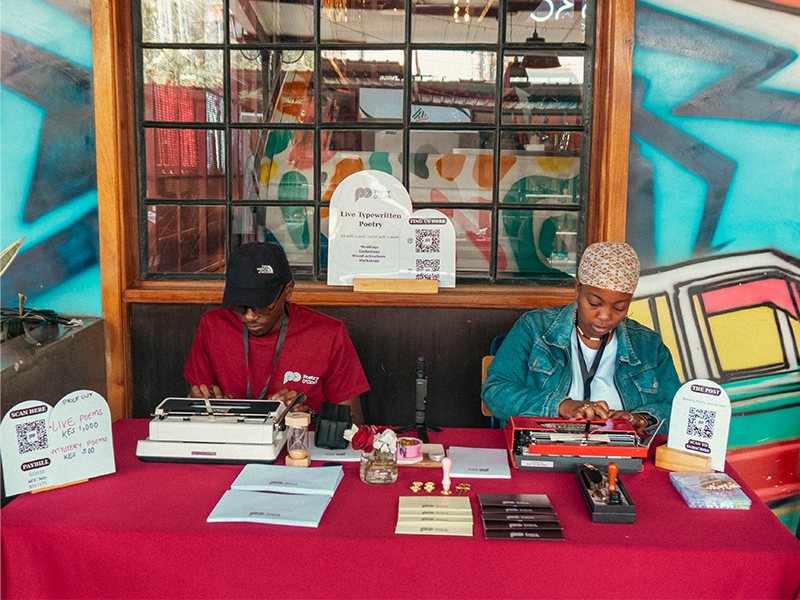
A guest approaches the table, sometimes with curiosity, sometimes with hesitation. The typewriter is already there, its presence both familiar and unexpected, offering a gentle answer to how live typewritten poetry works at events. The poet looks up. Nothing has been written yet, but something has already begun. This is where it all starts, not with performance, but with attention.
The first exchange
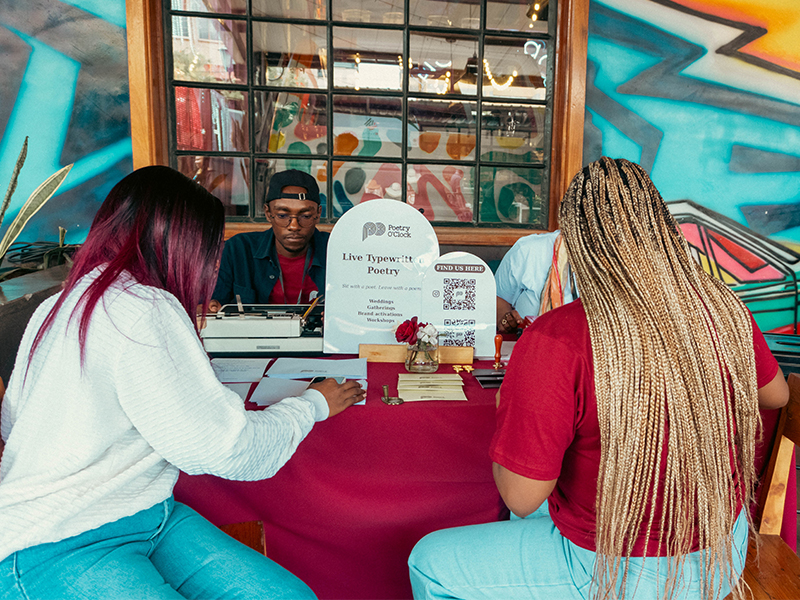
Live typewritten poetry is not a spectacle in the traditional sense. It does not ask for a stage or a microphone, though it can exist in those spaces too. More often, it unfolds through small, direct interactions between the poet and a guest.
Someone sits down. They may not know what to say at first. They might laugh, deflect, or offer something simple: a name, a feeling, a fragment of a story. Sometimes they arrive with something specific in mind, a memory they have been holding onto, or a person they want to honour. Other times, they are simply curious about what might happen.
The poet listens.This part is essential. This session is shaped not by performance, but by presence. The poet pays attention to what is said, but also to what is not said. The pauses, the tone of voice, the way someone chooses their words or avoids them altogether. These details form the beginning of the poem.
Writing in real time
Once the exchange settles into something clear enough to hold, the poet begins to write. At many events, this happens on a typewriter. The sound of the keys creates a kind of rhythm, a quiet signal that something is taking shape. People nearby often slow down when they hear it. They watch, sometimes from a distance, sometimes more closely, drawn by the physical act of writing.
The typewriter matters, not because it is nostalgic, but because it is visible. It allows the process to be witnessed. There is no screen, no editing behind the scenes. Each word is placed deliberately. Each line exists as it is written.
The guest waits. This waiting is part of the experience. It is not empty time. It is a space where anticipation and reflection meet. The person who has shared something of themselves begins to see it from a slight distance, even before the poem is complete.
The poet, meanwhile, is translating a human moment into language that feels true to it. This requires both skill and restraint. The poem must remain grounded in what was offered, while also allowing room for interpretation and resonance. It is a delicate balance.
The moment of receiving
When the poem is finished, it is handed to the guest. This is often the quietest part of the interaction. The guest reads. Sometimes immediately, sometimes after a pause. The room continues around them, but their attention narrows to the page in their hands. The words are not abstract. They are specific, shaped by something they shared, something they recognized as their own.
Reactions vary. Some people smile. Some laugh softly. Some grow still. Occasionally, there are tears, though not always for the reasons one might expect. A poem does not need to be heavy to move someone. Often, it is the clarity of being seen, even briefly, that creates the response. What matters is not how dramatic the reaction is, but how personal it feels.
The poem becomes an object they can hold. A piece of paper, folded or unfolded, carried in a pocket or a bag. Something that can be returned to later, in a different context, on a different day.
Why it feels different
Live typewritten poetry at events resonates in a way that is difficult to replicate through other forms of entertainment or engagement. Part of this is its immediacy. The poem is created in response to a real moment, not prepared in advance. It belongs to that specific exchange, shaped by the particular person who requested it. This makes each poem singular. It cannot be repeated in the same way.
But there is also something deeper at work. In many social spaces, conversation stays on the surface. People speak in ways that are expected, and familiar. Live typewritten poetry interrupts this pattern, gently. It invites a different kind of attention, both from the person receiving the poem and from those who witness the process. It creates a pause where people often find themselves sharing more than they intended, or listening more closely than they usually would.
This is why live typewritten poetry works across different kinds of events, from corporate gatherings to weddings, from brand activations to private celebrations. It adapts, not by changing its core, but by responding to the people within each space.
The role of the physical
There is a reason the details matter.The typewriter. The paper. The act of handing something from one person to another. These elements ground the experience in the physical world. In a time where much of communication happens through screens, the presence of something tangible carries a different weight. A typed poem is not easily dismissed or forgotten. It exists independently of the moment in which it was created.
Guests keep their poems. They fold them carefully. They take photos, but they also keep the original. Some place them in books. Others leave them on desks or frame them as a keepsake. Over time, the poem becomes part of their personal environment, something encountered again in quieter moments.This is where the experience extends beyond the event itself.
What poets notice
From the outside, live typewritten poetry might appear simple. A short conversation, followed by a short piece of writing. But for the poet, each interaction carries layers of observation. They notice how people approach the table. Some arrive quickly, confidently. Others circle for a while before sitting down. Some speak immediately. Others take time to find their words. These differences are not obstacles; they are part of the material.
Poets also notice patterns.Certain themes appear repeatedly, even across very different events. People speak about relationships, about transitions, about things they are holding onto or trying to let go of. They speak about joy, but also about uncertainty. About beginnings and endings, often at the same time. These are not unusual subjects. They are the fabric of everyday life. What live typewritten poetry does is bring them into focus, briefly, through language.
The shared atmosphere
Even for those who do not request a poem, live typewritten poetry changes the atmosphere of an event. It introduces a quieter centre. Guests passing by may pause to watch. They may listen to the sound of the typewriter, or catch a glimpse of a finished poem being read. These small observations accumulate, creating a sense that something more reflective is happening within the larger gathering.
This does not disrupt the event. It complements it. In corporate settings, it can soften the edges of formal interaction. In social celebrations, it can add depth without taking attention away from the occasion itself. It does not demand participation, but it remains available to anyone who feels drawn to it. Over time, this presence becomes part of the memory of the event.
After the event
The event ends, but the poems remain. This is one of the reasons live poetry continues to resonate. Unlike many experiences that are contained within a specific time and place, a poem moves with the person who receives it. It enters their daily life in small ways. They may read it again the next morning. Or weeks later. Or years later, rediscovered in a drawer or between the pages of a book.
The meaning can shift over time. A line that felt light at first may carry more weight later. A phrase that seemed simple may reveal something more complex when read in a different context. The poem does not change, but the reader does. This ongoing relationship is part of what makes the experience meaningful.
Extending the experience
For those who want to continue engaging with poetry beyond the event, there are other ways to encounter it more slowly. Receiving a poem by post, for example, creates a different kind of anticipation. The time between sending and receiving becomes part of the experience, allowing the words to arrive with a sense of intention. You can explore this through the Poetry O’Clock The Post: https://www.poetryoclock.com/snail-mail-club
Similarly, live typewritten poetry can be brought into different spaces, adapting to the needs and atmosphere of each setting. Whether it is a small gathering or a larger event, the core experience remains the same: a conversation, a moment of attention, and a poem that emerges from it.
A quiet kind of impact
At its core, live typewritten poetry at events is not about the poem itself, but about what happens around it. The conversation that begins it. The attention that shapes it. The moment of stillness when it is received. These are small things, but they stay.
If you are curious about experiencing this kind of exchange for yourself, you can explore more about how Poetry O’Clock creates these moments through live events or written letters. https://www.poetryoclock.com
