
What happens when a stranger writes you a poem is a surprisingly intimate question. At first, it sounds simple: you sit down, tell a poet something about yourself and wait while they turn your words into a poem. Yet the experience involves something more personal, for a few minutes, a stranger listens closely to a memory, feeling, relationship or thought that you have chosen to share, then interprets it through their own creative practice.
At Poetry O’Clock, this is the heart of our live poetry experience; a guest sits at the poetry desk, shares a little of their world and watches an original poem take shape on a typewriter. The result is something they did not arrive expecting to receive, but can leave with and keep.
The Experience Begins With a Conversation
A live poetry experience does not begin with the poet immediately reaching for the typewriter, it begins with listening. When a guest sits down, the poet may ask a few questions to understand what they would like the poem to hold. A guest might talk about a person they love, an important occasion, a place that feels significant or something they have been thinking about recently and sometimes the most useful detail is surprisingly ordinary.
The conversation also gives the guest an opportunity to decide what they want to share. There is no expectation that they need to tell their entire story, a few meaningful details can be enough to begin. This makes the experience collaborative, the guest supplies the memory, feeling or idea, while the poet decides how to interpret it through language.
Then the Typewriter Becomes Part of the Conversation
Once the poet has enough context, the writing begins and the sound of the typewriter changes the atmosphere. Each letter appears physically on the page, one character at a time. There is no screen displaying an unfinished paragraph and no cursor waiting for the poet to endlessly rearrange everything later.
For the guest, this means they can watch the poem being made. The typewriter becomes part of the experience where the physical process makes the writing visible and gives the guest a sense of anticipation as the page gradually fills.
At Poetry O’Clock, our poets work within the practical limitations of live writing. They have a short conversation, a limited amount of time and a physical page on which the poem needs to fit. The poem has to emerge from the specific details the guest has shared rather than from a prepared template. That combination of attention and limitation is part of what makes real-time poetry interesting.
What Does a Guest Actually Tell the Poet?
Some guests arrive with a clear idea and they may want a poem for a birthday, anniversary, wedding, friendship or personal milestone. Others may simply want to see what happens when they give a poet a few details and allow them to interpret them.
The poet listens for the emotional centre of what has been shared and this is important because a personalized poem does not need to repeat the guest’s story word for word. The poet’s role is to find an image, phrase, rhythm or connection that can transform the information into something new.
What Makes a Poem Feel Personal?
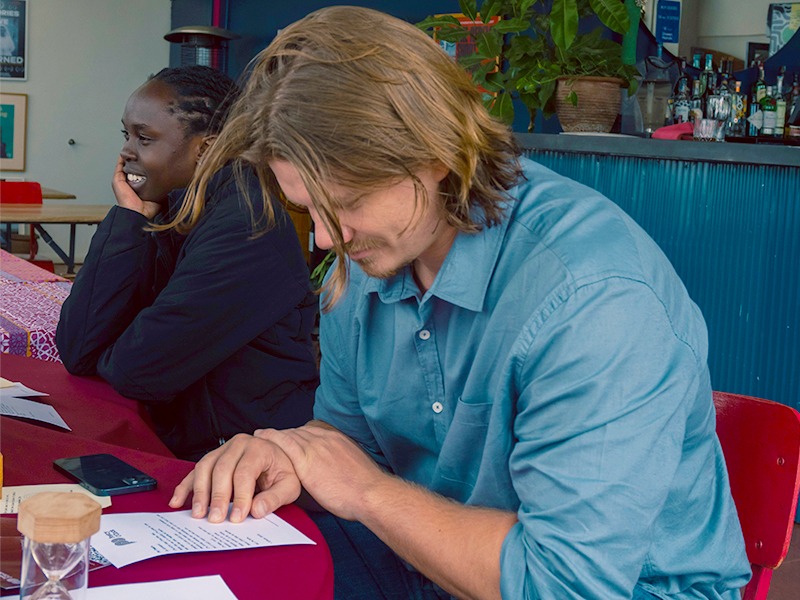
Personalisation comes from specificity, a poem that could apply to anyone may be beautiful, but a poem that contains a detail only one person would recognise carries a different kind of significance. It might mention a particular habit, shared memory, favourite place or small detail from a conversation; these details give the poem an anchor.
Imagine telling a poet that your father always waited outside the school gate when it rained. That single image could become the starting point for a poem about care, childhood and the ways people show love without saying much. This is one reason storytelling matters to the live poetry experience, the guest provides fragments of a real life, and the poet decides how those fragments can become language.
The Poet Has to Make Decisions Quickly
Writing a poem in real time is very different from writing privately at home. A poet working alone can draft a line, delete it, leave the poem overnight and return to it the next morning. A live poet has a guest sitting nearby and a finite amount of time in which to create something original and that creates a particular kind of creative concentration.
The poet has to decide which details matter most and to do that, they have to listen while also thinking about language. They need to find an opening, develop an idea and bring the poem to a satisfying close, all while working within the physical limitations of a typewriter and page.
The Guest Becomes Part of the Creative Process
A live poetry experience is unusual because the person receiving the work contributes to its creation without writing it themselves. Their memories provide the material and their reactions during the conversation can give the poet further clues. This exchange is part of what makes the experience memorable, the guest is receiving a finished object they have participated in the moment from which the object emerged.
Research on storytelling and human connection from an article on Psychology Today has explored how sharing personal narratives can help people make meaning, understand one another and strengthen relationships. This helps explain why experiences built around listening and personal stories can feel particularly memorable.
From a Few Words to Something You Can Keep
Once the poem is finished the guest gets to read it for the first time. There is often a small moment of recognition as they encounter familiar details arranged in a completely different way. That is part of the pleasure of receiving a personalized poem, the words may have originated in something the guest said, but the final form could reveal a connection they had not previously considered.
The poem is then physically handed to them and this matters in a culture where much of our communication exists on screens. A typewritten poem is a physical record of a particular conversation, created at a particular time for a particular person and the object carries the memory of the experience with it.
Why Live Poetry Works at Celebrations and Gatherings
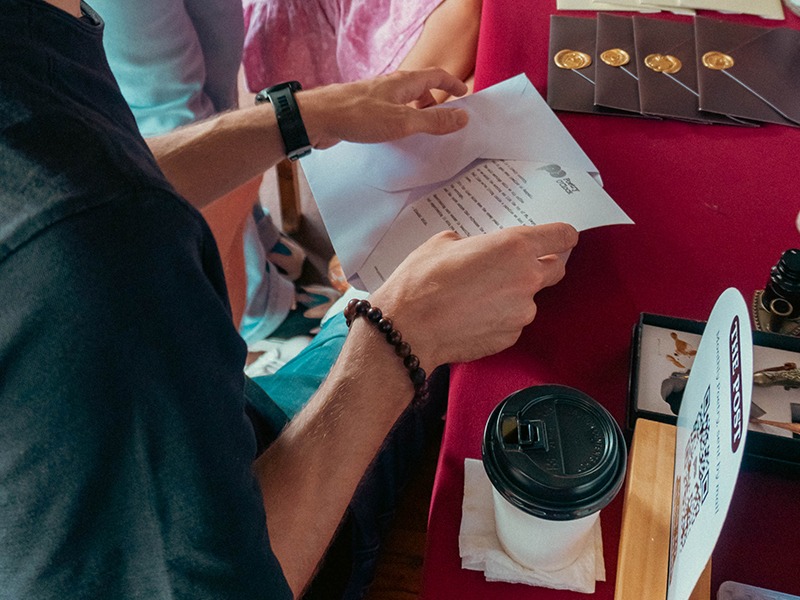
A live poetry experience can fit naturally into occasions where people are already coming together to celebrate, connect or create memories.
The appeal extends beyond any particular city or type of event because the foundation of the experience is universal: conversation, memory, creativity and the desire to preserve something meaningful.
The Value of an Unexpected Creative Experience
There is something valuable about experiences that leave room for discovery. You may attend a live poetry event expecting to receive a short poem and leave thinking about a memory you had not considered in years. You might arrive with one story and discover that the poet has focused on a completely different detail. You might share something ordinary and find that it becomes the most memorable part of the poem, that uncertainty is part of the experience.
This is also why live poetry can work well as a gift, instead of deciding exactly what someone should receive, you can give them an opportunity to participate in creating something personal.
A Stranger, a Story and a Typewriter
A live poet does not need to know your entire story to write something that feels personal, they need to listen carefully to the part you choose to share. That is the quiet exchange at the centre of Poetry O’Clock’s live poetry practice. A guest brings a few words, memories or feelings and a poet brings attention, craft and interpretation while the typewriter gives the process a physical form.
Through our Live Poetry experience, Poetry O’Clock creates opportunities for guests to experience poetry as something made in conversation and received in physical form. The idea can travel anywhere because the ingredients are simple: one person willing to share a story, another willing to listen, and enough time to turn those words into something new.
Sometimes a memorable experience can begin with two people sitting across a table, one person telling a story and another listening closely enough to turn it into a poem.
