
Why constraints can make poetry better becomes easier to understand when we consider what happens when a poet has fewer choices to work with. A fixed number of lines, a particular rhythm, a required word, a specific theme or a limited amount of time can initially seem restrictive. Yet these boundaries can give a poem direction, helping the writer make sharper decisions about language, structure and meaning.
Poetry has always worked with constraints in different forms; sonnets, haiku, villanelles, sestinas and other poetic forms establish particular rules around rhythm, repetition, line length or structure. Contemporary poets continue to invent their own limitations, using rules as creative prompts rather than barriers. The result can be writing that feels more focused, surprising and deliberate.
What Are Constraints in Poetry?
A poetic constraint is a rule or limitation that shapes how a poem is written. The constraint can be formal, such as a traditional rhyme scheme, or something a poet creates specifically for an individual piece. A constraint might require a poet to:
- Write within a specific number of lines.
- Use a particular number of syllables.
- Begin each line with a particular letter.
- Repeat certain words or phrases.
- Avoid using a specific letter.
- Write around a particular subject.
- Complete the poem within a set period.
- Use words gathered from a conversation or source.
- Follow a particular poetic form.
These rules can operate at different levels, sometimes the reader notices them immediately. At other times, they remain almost invisible while quietly influencing the poem’s construction. The Poetry Foundation’s discussion of poetic convention notes that forms provide poets with structure and shared tools while still leaving room to challenge or reinterpret those conventions.
Why Limitations Can Help a Poet Begin
One of the most difficult parts of writing poetry can be deciding where to start. A blank page presents almost unlimited possibilities; you can write about anything, in any form, at any length. That freedom can be useful, but it can also make the first decision feel unnecessarily difficult, a constraint immediately changes the question.
Instead of asking, What should I write?, the poet might ask, What can I say in eight lines? or What happens if every line begins with the next letter of the alphabet? and suddenly, the page has somewhere to begin.
Poet Rebecca Hazelton, writing for the Poetry Foundation, describes constraints as a way of reducing the anxiety of the blank page by taking some choices away while creating new choices within those boundaries. That distinction is important, a constraint removes certain possibilities, but it also directs attention towards the possibilities that remain.
Constraints Make Language More Precise
When space is limited, every word has to work harder; a poem with a fixed number of lines cannot endlessly explain an idea. A poet has to decide which detail carries the most weight and which words can be removed without losing the thought which can strengthen the writing.
A poet working within a short form may discover that one image communicates something that several explanatory sentences cannot. A required rhyme may lead to an unexpected word. A limited line length may force a different sentence structure and the limitation becomes a reason to reconsider familiar choices.
This is one of the practical benefits of writing poetry with constraints. The poet becomes more conscious of rhythm, repetition, line breaks, sound and the relationship between individual words.
Constraints Can Lead to Unexpected Ideas
Creative work often develops through problems, a poet may know what they want to say but discover that the obvious wording does not fit the form. They then have to search for another expression and that search can produce an image, association or phrase they would not have reached through the easiest route.
The Poetry Foundation’s writing on constrained poetry describes this process as a form of productive resistance. When a writer is pushed away from habitual choices, they may experiment with unfamiliar vocabulary and structures. The constraint creates a small problem, and solving that problem can become part of the creative process. This is why a poem can sometimes become more interesting when the writer has less freedom.
Form Can Teach a Poet About Craft
Constraints are also useful because they give writers a practical way to study technique. Writing a sonnet, for example, requires attention to structure, rhythm and rhyme. Working with a sestina introduces repetition and the changing relationship between recurring words while a haiku places particular pressure on brevity and image.
Working within different structures can help a writer understand what language is doing. The Poetry Foundation’s guide to writing in form argues that formal practice can strengthen skills that remain useful even when a poet returns to free verse.
A poet who has experimented with rhyme may become more attentive to sound and someone who has worked with strict line lengths may become more conscious of pacing. A writer who has explored repetition may better understand how a recurring phrase can change meaning depending on its context; this is when constraint becomes a form of practice.
Constraints Can Make Repetition More Meaningful
Repetition is one of poetry’s most powerful tools, but repeated language can easily become predictable if it does not develop. Constraints can make repetition purposeful in that a repeated word might appear in different contexts throughout a poem, gathering new associations each time. A recurring line can sound different after the speaker has changed. A fixed structure can allow an image to return while its meaning shifts.
This is part of what makes forms such as the villanelle and sestina useful exercises. Their rules require repetition, but the poet must continually find new ways to place familiar language into unfamiliar contexts. The repetition creates a framework and the poet supplies the movement within it.
Time Can Be a Creative Constraint
Not all constraints have to exist on the page, time can also shape poetry. Writing within ten minutes, for example, changes the relationship between thought and revision. The poet has to trust certain instincts, choose quickly and accept that the poem will not be endlessly refined, this can be particularly interesting in live poetry.
When a poem is being created for someone in real time, the poet has a limited window in which to listen, interpret, select details and write. The pressure is gentle but real and there is no opportunity to spend several days searching for the perfect opening, that limitation can encourage attentiveness. The poet has to identify what matters within the conversation and make creative decisions while the moment is still unfolding.
How Constraints Work in Live Poetry

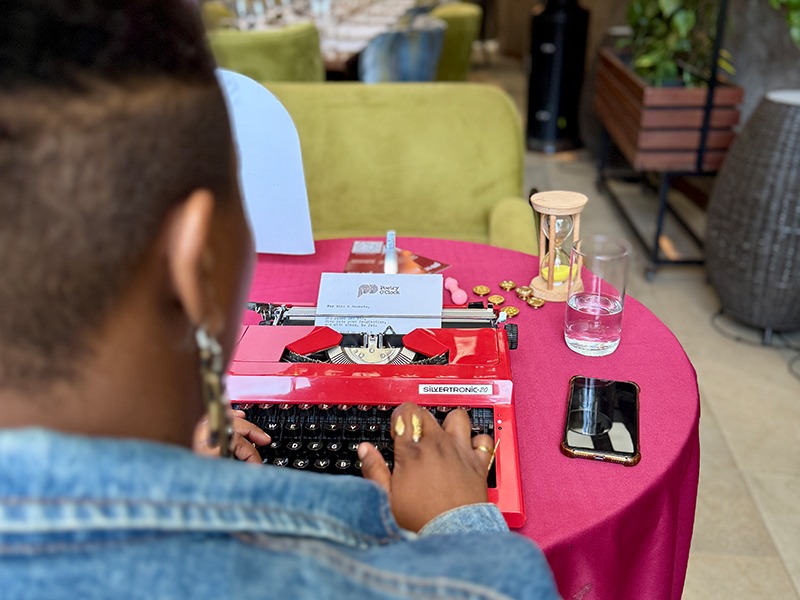
At Poetry O’Clock, constraints are part of the practical reality of creating poetry for guests. Our live poets work from a conversation, a limited amount of time and the physical limitations of a typewriter. The guest may share a memory, feeling, relationship, occasion or small detail, and the poet has to decide what can become the centre of the poem.
The typewriter adds another layer to the process, once words are committed to the page, they cannot be rearranged with the same ease as text on a screen. The poet has to think about the sentence, line and rhythm before continuing. These boundaries do not determine what the poem will say but they create the conditions in which the poet has to make decisions.
That is particularly important when writing for someone the poet has just met. There is a limited amount of information, limited time and one conversation from which to create something personal, this is when the constraint becomes part of the craft.
What Happens When the Constraint Is Personal?
Some of the most interesting constraints come directly from the person or occasion a poem is being written for. A poem might need to include a particular memory, name, place or phrase. It might be written for a birthday, anniversary, wedding or professional milestone. These details narrow the subject while also giving the poet something concrete to work with.
Instead of searching through every possible idea, the poet begins with a particular person and their story. That specificity can make the resulting poem feel more focused. The same principle can be useful for anyone writing poetry, if you are struggling with a blank page, give yourself a smaller assignment:
- Write a poem about one object in the room.
- Use only one memory.
- Write eight lines.
- Begin every line with the same word.
- Include three sensory details.
- Write for ten minutes without editing.
- Choose five words before you begin and use all of them.
A constraint does not have to produce a finished poem, it can simply get the writing moving.
The Difference Between Constraint and Restriction
A useful constraint should create a challenge without taking away the reason for writing. If a rule becomes so complicated that the poet spends all their attention satisfying it, the poem can begin to feel like a puzzle rather than a piece of writing. The most useful constraints leave room for interpretation.
They give the poet something to work against while still allowing instinct, emotion and imagination to influence the result. The Poetry Foundation’s recent work on Oulipo and literary constraints similarly explores how deliberately constructed rules can generate unexpected forms of writing. The goal of this is to see what the rules make possible.
Why Constraints Can Make Poetry Better
Why constraints can make poetry better comes down to the relationship between freedom and decision-making. A completely open page offers endless possibilities, while a constraint gives the writer a starting point, a boundary or a problem to solve. Within that boundary, the poet still has to choose and those decisions are where much of poetry’s craft lives.
At Poetry O’Clock, we see this every time a poet creates a poem in real time. A conversation, a person, a typewriter and a limited amount of time may seem like a narrow set of conditions, but they provide enough structure for something unexpected to emerge.
Sometimes creativity needs an open field and sometimes it needs a boundary. The interesting work often begins when you discover what you can make within it.
