
Years after it was first introduced, people often find asking themselves why handwritten letters still matter on World Letter Writing Day and the reason is, there is a particular pleasure in writing something that cannot be produced with a quick tap. You have to decide where the first sentence belongs, how much of the page to fill, whether to leave space between your thoughts, and what to do when you make a mistake. There is no autocorrect waiting to tidy things up and no notification suggesting that something else deserves your attention.
The practice of writing a letter may belong to a much older tradition of communication, but it does not have to remain there. It can be a creative ritual, a way to maintain relationships, an exercise in reflection, or simply a welcome reason to spend an hour away from a screen.
What Is World Letter Writing Day?
World Letter Writing Day is observed every September 1 to encourage people to return to the practice of writing and sending handwritten correspondence. The day was launched in 2014 by Australian author and artist Richard Simpkin, who wanted to encourage people to rediscover the practice of letter writing.
You can write one letter, exchange correspondence with a friend, introduce someone younger to letter writing, or simply spend time exploring stationery and putting your thoughts on paper. That flexibility is part of its appeal, letter writing appreciates analog communication by offering a different kind of activity altogether.
Letter Writing Is a Practice, Not Just a Form of Communication
It is easy to think of a letter simply as an older way of delivering information. But writing one is a process that begins with a blank page and you get to decide what belongs in the letter and what can remain unsaid. You physically move through the act of writing rather than composing, editing and sending within the same digital interface. This can make letter writing surprisingly immersive.
The process encourages a different relationship with language where a sentence may be rewritten because it does not feel quite right or a page may end before you have finished, requiring another sheet. Those small limitations are part of the creative experience.
Letter writing has also played an important role in documenting everyday life, relationships, migration and social change. The Smithsonian’s National Postal Museum explores this history through its collection and research on letter writing in America, showing how personal correspondence can provide a record of ordinary lives as well as major historical moments.
The Quiet Creativity of a Blank Page
Letter writing can also be approached as a creative practice without becoming overly formal. You can experiment with the form itself. Try:
- Beginning with a question rather than a greeting.
- Writing about one specific memory instead of summarising your entire life.
- Including a short poem or original piece of writing.
- Drawing something in the margin.
- Choosing stationery that reflects the recipient.
- Writing a letter around a particular theme.
- Leaving a few intentional blank spaces on the page.
- Including a photograph, pressed flower, ticket stub, or other small paper keepsake.
These details turn correspondence into a small creative project. This is also where letter writing connects naturally with journaling, poetry, scrapbooking, illustration, and other offline creative practices. The letter becomes a space where several forms of creativity can meet.
Why Stationery Is Part of the Experience
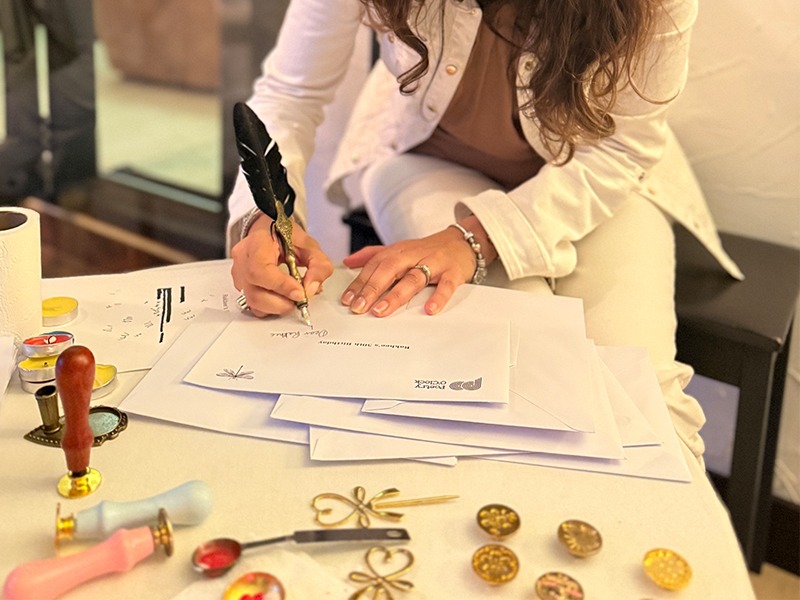
There is a reason stationery has remained closely associated with letter writing. Paper changes how a message feels before it has even been read. A textured sheet, coloured envelope, fountain pen, unusual stamp, or handwritten address can create a sense of occasion around an otherwise ordinary piece of correspondence.
You can make use of the stationary you already have and add onto it as you get into the practice. A good letter-writing kit might contain:
- A few sheets of writing paper.
- Envelopes in different sizes.
- A pen you enjoy using.
- Stamps.
- A notebook for drafts or ideas.
- Small pieces of paper for notes or illustrations.
Keeping these materials together makes the practice easier to return to. Over time, choosing paper and writing tools can become part of your own creative ritual.
Letter Writing as a Form of Slow Living
The renewed interest in handwritten letters sits naturally alongside the wider interest in slow living and offline hobbies. Slow living is all about becoming more deliberate about where your attention goes. Letter writing offers a practical example because the activity naturally limits speed.
You cannot write down a page as quickly as you can type a message and sending it includes addressing an envelope and putting it into the postal system. The process contains pauses which can be useful. They give you an opportunity to spend time with one thought rather than moving between several conversations at once. They also create a clear beginning and end to the activity: sit down, write, fold, seal, send. In that sense, letter writing can become a small offline ritual instead of another task on a list.
Letter Writing Ideas to Commemorate World Letter Writing Day
If World Letter Writing Day gives you a reason to write but you do not know where to start, try giving yourself a specific prompt.
- Write a letter about one memory – Choose a memory that you and another person share. Describe the details you remember and why the moment has stayed with you.
- Start a correspondence – Choose a friend or family member who lives elsewhere and suggest exchanging letters once a month. The structure can make the practice easier to maintain.
- Write to someone from another generation – Ask an older relative about a period of their life, or introduce a younger person to the experience of writing and sending physical mail.
- Create a themed letter – Instead of writing about everything that has happened recently, choose one subject. It could be books you have read, places you want to visit, songs you have been listening to, or things you are currently learning.
- Write a letter to your future self – Document what your life looks like now and choose a future date on which to open it.
- Write a letter you never send – Use the page as private space for your thoughts, questions, gratitude, or reflection.
Keeping the Practice Alive Across Generations
One of the most interesting aspects of World Letter Writing Day is its potential to introduce letter writing to people who have never experienced it as part of everyday life. For someone accustomed to instant messaging, receiving a physical letter can be an entirely unfamiliar process. There is the envelope, the handwriting, the stamp, the waiting, and the decision about where to keep it.
Introducing children and younger people to letter writing can therefore become a small lesson in communication history and creative expression. They can learn how addresses work, explore stamps and stationery, practise handwriting, and experience communication that does not depend on a screen.
The practice can also connect generations where older family members may have stories about writing letters before email and mobile phones became commonplace, while younger people can bring their own creative interpretations to the tradition.
How Poetry O’Clock Reimagines Letter Writing
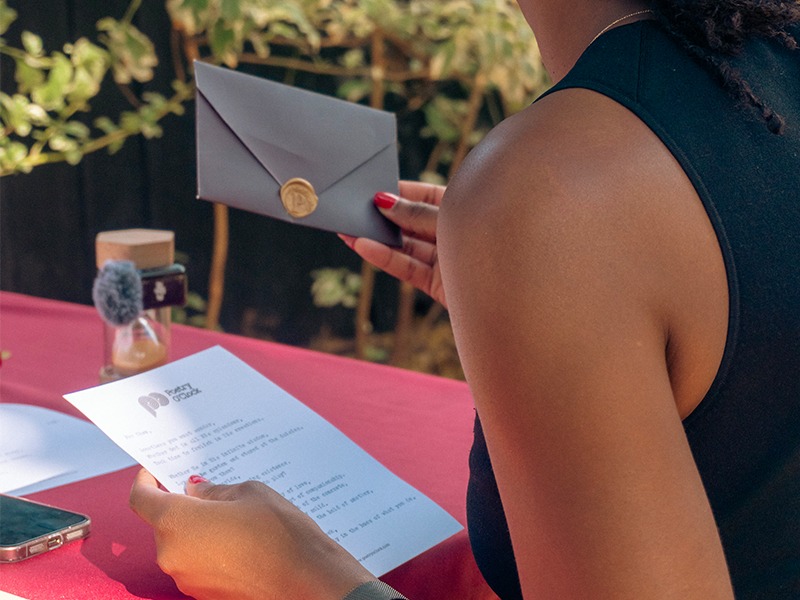
At Poetry O’Clock, we are interested in what happens when writing becomes an experience. That idea is central to Keepsake Soirée, our intimate writing experience, where guests are invited to put pen to paper, explore personal prompts, and create something they can take with them. Letter writing becomes part of a wider creative ritual involving conversation, reflection and physical materials.
The Post takes the idea of physical correspondence beyond a single writing session. It is Poetry O’Clock’s custom poetry that is written to order and sent by mail. The Post is centered around paper, presence and the quiet pleasure of receiving something in the mail. The experience brings together the anticipation associated with physical correspondence and the discovery of receiving thoughtfully selected literary material. It can also be given as a gift, allowing someone else to experience the pleasure of receiving something tangible through the post.
Together, these experiences reflect Poetry O’Clock’s wider interest in bringing words back into physical spaces. Writing becomes something you can sit with, share and keep, while paper and the act of receiving give the experience a sense of occasion that digital communication often moves past quickly.
A Reason to Return to the Page
World Letter Writing Day is ultimately about making room for a particular kind of attention. Writing by hand gives us a slower creative process, a physical relationship with language, and the freedom to make something without needing to publish it, optimise it, or immediately share it. This September, choose a piece of paper and begin writing to someone you know, someone you have lost touch with, someone from another generation, or simply yourself.
At Poetry O’Clock, we continue to explore what becomes possible when words are given a physical form and enough time to develop. Through Keepsake Soirée, Table for Two, The Post, and live typewritten poetry, we create spaces where writing can be experienced rather than rushed through.
This World Letter Writing Day, perhaps the best way to celebrate the tradition is to give it your own interpretation. Pick up a pen, start with one page, and see where the words take you.
