
The Question People Ask Before They Sit Down
Are live poems truly unique? There is often a moment, usually just before someone sits down for a live poem, when they ask a version of the same question. “Has anyone ever asked you for this before?” Sometimes the question arrives lightly, almost jokingly. Other times, it comes with visible hesitation. A person might hold the edge of the table for a second longer before speaking. They may explain that they do not know what to say, or that their story is probably ordinary, or that perhaps every poem eventually sounds the same. It is an understandable concern.
We live in a time shaped by repetition. So much of what people encounter online arrives through templates, recycled language, familiar captions, predictable sentiments. Even deeply personal moments are often translated into formats designed to resemble one another. Engagement announcements, apologies, love letters, birthday tributes, condolences. The language of public life has become increasingly standardized, even when the emotions underneath it remain real.
So when someone approaches a typewriter and begins sharing fragments of themselves with a stranger, there is often an unspoken question beneath the conversation: Can something made in a few minutes really belong only to me?, Are live poems truly unique? The answer is yes, though perhaps not for the reasons people expect.
What Makes A Live Poem Singular?
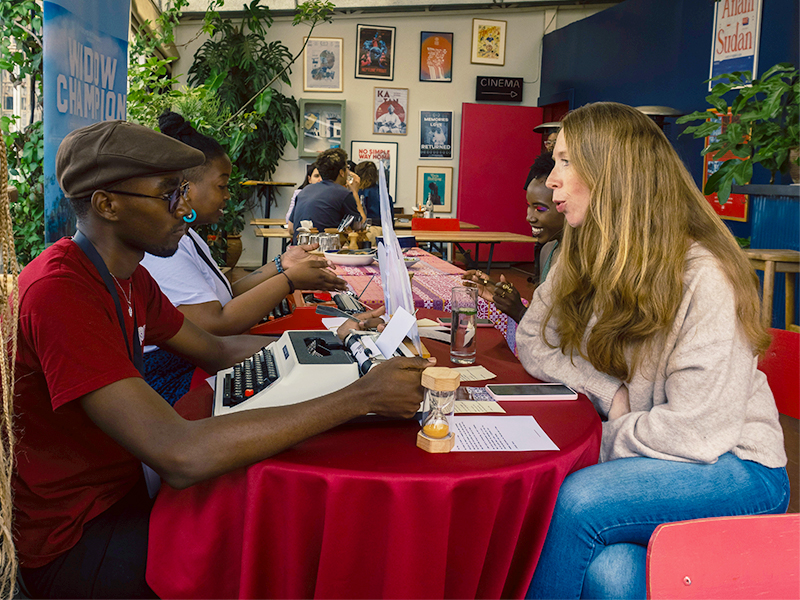
A live poem is not unique because no one has ever experienced heartbreak before, or grief, or longing, or joy. Human emotions are ancient. People have been writing about missing someone, hoping for something, forgiving someone, or trying to understand themselves for centuries. What makes a live poem unique is not the invention of entirely new feelings. It is the precise way one particular life carries them. At Poetry O’Clock sessions, people rarely begin with dramatic stories. More often, they begin with details. A woman once described the way her grandmother folded shopping bags into perfect triangles and stored them beneath the kitchen sink. Someone else spoke about the silence inside a car after an argument, when neither person turned off the radio. A father explained that every morning before school, his daughter taps twice on the door before leaving because she believes it brings good luck.
These are not grand revelations. They are small observations from ordinary life. Yet they contain entire emotional worlds. The typewriter makes this especially visible. Unlike digital writing, live poetry unfolds slowly enough for people to witness its making. The keys strike paper one letter at a time. Sentences cannot fully disappear once written. Mistakes remain faintly visible beneath correction fluid or crossed-out lines. The poem develops in physical space, carrying evidence of the moment in which it was created. People often watch quietly while the typing happens. Sometimes they lean forward slightly when they hear a phrase that belongs unmistakably to them. Sometimes they laugh softly in surprise. Occasionally, there is silence not because nothing is being felt, but because something has been recognized with unusual accuracy. That recognition is part of what makes the poem singular.
Not every detail shared during a live poetry session enters the final piece. In fact, many do not. A poet listens not only for information but for emotional rhythm. The pause before someone answers. The sentence they almost say differently. The detail they return to without realizing it. Two people might speak about the same experience and receive entirely different poems because meaning lives differently inside each person. Consider grief. One person remembers grief through sound: the voicemail they can no longer bring themselves to delete. Another remembers it through routine: still setting out two mugs before realizing only one is needed. The emotional territory may be shared, but the architecture of memory is never identical.
How Ordinary Details Become Personal Language
This becomes especially apparent during public events.
What Happens At Weddings
At weddings, people often assume the poems will revolve around romance alone. Yet many wedding poems quietly become about time. A bride remembering the smell of her childhood home before leaving it behind. A father noticing how differently his daughter laughs as an adult. Friends recognizing the strange tenderness of watching each other grow older.
What Happens At Corporate Gatherings
At corporate gatherings, poems unexpectedly drift toward exhaustion, ambition, loneliness, or the relief of finally feeling seen outside professional roles.
What Happens At Community Events
During community events, strangers frequently reveal stories they have never said aloud before, perhaps because the interaction exists outside the structures of ordinary conversation. The temporary nature of the exchange creates a certain freedom. There is no expectation of long-term intimacy. Only attention. People are often surprised by how quickly they become honest when someone is listening carefully.
The Poem Is Created Collaboratively
This is another misunderstanding about live poetry: that the uniqueness belongs entirely to the poet. In reality, the poem is shaped collaboratively. The poet may choose the language, rhythm, and structure, but the emotional material comes from the person sitting across the table. Every session contains circumstances that will never fully repeat. The weather that afternoon. The noise in the background. The interruption halfway through a sentence. The fact that someone almost did not sit down at all.
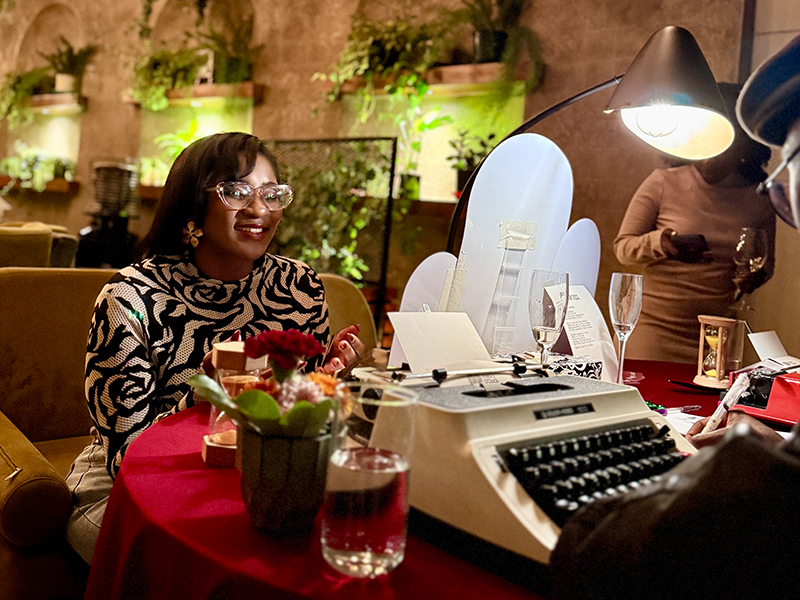
A poem written live absorbs these conditions quietly. It becomes part document, part emotional artifact. This may be why people often hold onto live poems differently than they hold onto other forms of writing. At the end of a session, many readers tuck away their poems carefully before placing it in a bag or coat pocket. Some photograph it immediately. Others read it several times before standing up. There are people who return years later carrying the original page, now softened at the folds. Coffee stains. Creased corners. Ink fading slightly where fingers have touched the same lines repeatedly.
Why People Hold Onto Live Poems
What they preserved was not only the poem itself, but the memory of being witnessed. The physicality of the poem matters here. A typewritten poem exists as an object shaped by time and presence.Unlike text that arrives instantly on a screen, it carries the imperfections of live creation. The uneven pressure of certain keys. The occasional misalignment of letters. The texture of paper moved from one pair of hands to another. These details resist duplication. Even when a poet revisits similar emotional territory, the resulting poem emerges differently because the encounter itself is different.
This does not mean every live poem is extraordinary in a dramatic sense. Many are quiet. Some are playful. Others remain deliberately simple. Uniqueness does not always announce itself loudly. Often, it appears through specificity. A sentence that could only belong to one person. A comparison rooted in a private memory. An image so familiar to the recipient that they begin smiling before they fully understand why.
The Emotional Weight Of Small Details
There are moments during Poetry O’Clock sessions when someone says, “I don’t know if this matters,” before sharing the exact detail that becomes the centre of the poem. That uncertainty is deeply human. People regularly underestimate the emotional significance of their own lives because they inhabit them every day. Familiarity can make meaningful experiences appear ordinary. Yet poetry has always drawn power from ordinary things observed carefully.
The poet Mary Oliver once wrote extensively about paying attention to the world around us, not because every moment is spectacular, but because attention itself transforms experience into something felt more fully. In many ways, live poetry operates similarly. It slows interaction down long enough for people to notice what was already present. Sometimes the uniqueness of a live poem becomes visible only later. A guest may initially laugh and thank the poet politely before walking away. Then hours afterward, they peek at the paper again in private and encounter a line differently. Or they place the poem inside a book. Or mail it to someone else. Or keep it inside a drawer for months before rereading it during a difficult season.
What Continues After The Poem Is Finished
The life of the poem continues beyond the moment it was typed. This is part of why live poetry resists becoming purely transactional, even at large events. What people receive is not simply customized writing. It is evidence that attention was given carefully and specifically to their interior world, however briefly. In contemporary life, that experience has become surprisingly rare.
Slowing Down Long Enough To Listen
Much of modern communication prioritizes speed over presence. Messages are skimmed. Responses are shortened. Conversations fracture across notifications and distractions. People often move through entire days without feeling fully heard. A live poetry session interrupts that rhythm. For a few minutes, someone speaks while another person listens with the intention of transforming those words into something lasting.
Not permanent. Paper fades. Ink softens. Memory changes. But lasting enough to return to. Lasting enough for someone to recognize themselves inside language.
A Poem That Could Only Belong To One Person
Perhaps that is the deeper answer to the question of uniqueness. A live poem is unique not because it emerges from completely unprecedented emotions, but because no one else has lived a life in precisely the same arrangement. No one else carries the same collection of memories, gestures, losses, private jokes, routines, fears, hopes, or silences. And when those fragments are spoken aloud, even briefly, they leave traces that shape the poem into something that could not have belonged to anyone else.
The typewriter simply makes the process visible.
If you would like to experience a live poem in person or learn more about the quiet exchanges that shape Poetry O’Clock sessions, you can explore our live poetry experiences and gatherings through the Poetry O’Clock practice here: https://poetryoclock.com/. Sometimes the smallest conversations leave the longest echoes.
