There is a particular kind of silence that arrives just before someone begins to speak about something that matters to them. It’s not an empty silence, it’s full, almost heavy with consideration, as if the words are still choosing their form before they are allowed into the air. At Poetry O’Clock live typewritten poetry sessions, this silence is familiar.
It appears when someone sits across the typewriter, hands resting lightly on the table, eyes moving between memory and the present moment. It appears again when a conversation begins, not the kind that fills space, but the kind that carefully opens it. Someone might say, almost casually, “I don’t know if this is something you can turn into a poem,” and then pause, as if testing whether their story is allowed to exist in language. This is often where the poem begins.
The Conversation Before the Poem
Conversations that become poems rarely begin like declarations. They begin in fragments. A half-sentence about a childhood kitchen. A name that is spoken more softly than the rest of the story. A moment described not for its importance, but for its weight. A person might talk about the way their mother used to fold letters into envelopes with unnecessary care, pressing down the edges as if sealing something more than paper. Another might describe a goodbye that did not feel like a goodbye until much later, when the silence afterwards began to stretch differently in memory.
These are not yet poems. They are lived experiences still in their original form. Unstructured, unedited, still warm with the immediacy of having been survived. The poet listens not for what is dramatic, but for what is true in its smallest detail. Because often, it’s not the headline of a story that becomes the poem. It’s the way someone hesitated before answering a question. It’s the sentence that was almost not said. It’s the way a memory changes shape as it’s spoken out loud.
Listening as a Form of Writing
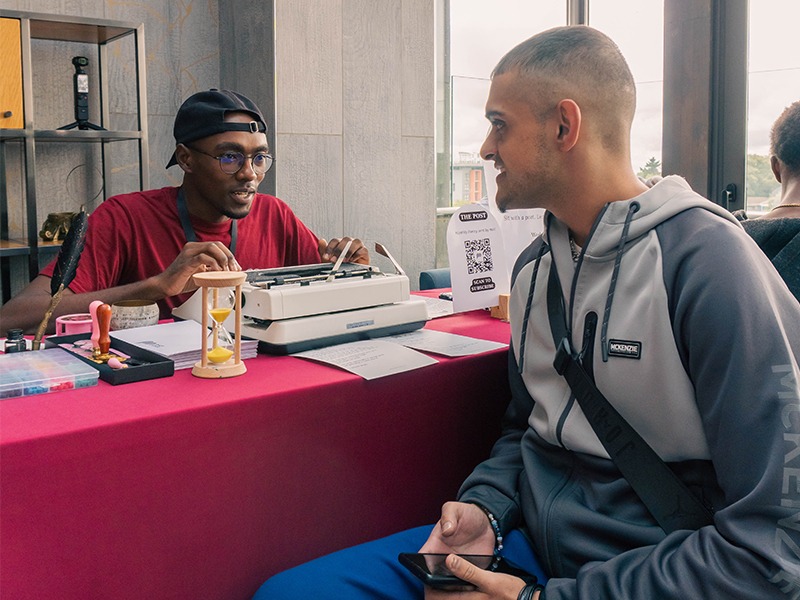
In many ways, the act of turning conversation into poetry begins long before the typewriter is touched. It begins in listening that is unhurried enough to notice the rhythm of how someone speaks. Some people speak in long, continuous streams, as if they are afraid the memory might disappear if they pause. Others speak in careful steps, stopping often, allowing silence to do some of the work. Both contain poetry, but it requires a different kind of attention to hear it. The poet is not only listening to what is being said, but also to what is circling around it.
There is often a second story beneath the first one. A sentence about missing someone might carry within it an entire history of unsent messages. A casual mention of a place might hold an entire version of a life that once existed there. To listen in this way is to treat conversation not as information, but as material.
The Moment the Typewriter Enters
At Poetry O’Clock, there is a shift that happens when the typewriter is placed in front of a conversation. It is subtle, but noticeable. The conversation does not stop, but it begins to slow down. Words become more considered, not because they are being performed, but because they are being witnessed differently now. The sound of the keys introduces a rhythm that feels almost like punctuation for memory. Each strike is deliberate. Each pause between sentences becomes part of the composition.
As the poet begins to type, the conversation does not disappear. Instead, it changes form. What was spoken becomes something else, something that can be returned to. Something that can be held.
Translation, Not Transformation
There is a misconception that poets take conversations and “turn them into” poems as if the original material disappears in the process. In practice, it is closer to translation than transformation. The conversation remains intact, but it is moved into another language. The language of line breaks, rhythm, spacing, and silence.
A sentence like “I didn’t know it was the last time I would see them” does not need embellishment to become poetic. It only needs to be placed with care. To be given space around it. To be allowed to breathe differently on the page than it did in speech. Poetry, in this sense, is not an invention. It is a rearrangement of attention. The poet asks: what happens if this moment is slowed down? What happens if this memory is held a little longer than it was originally held in real time?
The Role of Detail
What often makes a conversation into a poem is not the story itself, but the details that hold it in place. Someone will mention the colour of a curtain in a childhood room, and suddenly the entire memory becomes visible. Another will recall the exact phrasing of a message they still think about years later. These details are not decorative. They are structural. They are the points where emotion attaches itself to language.
In the typing process, these details are not elevated or exaggerated. They are preserved. The poet’s task is not to improve them, but to ensure they remain intact as they move into a new form.
When Someone Reads Their Poem for the First Time
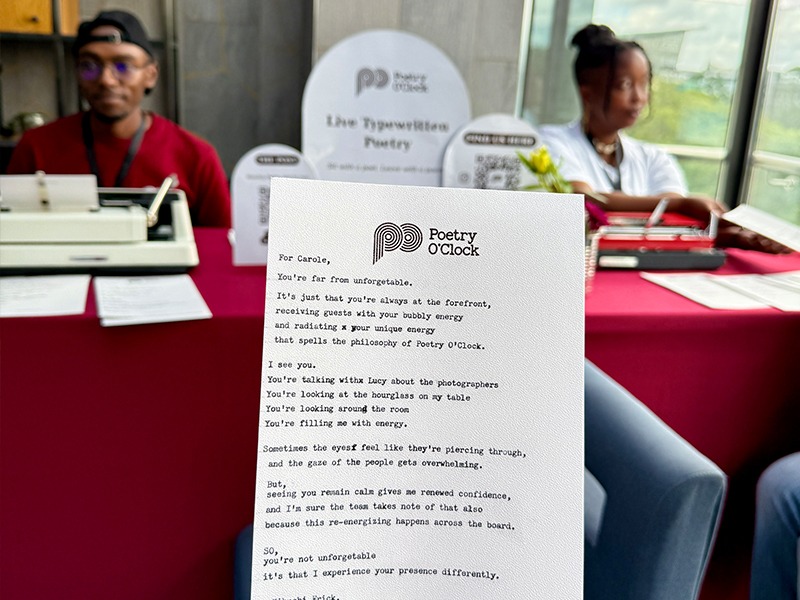
There is a moment that often arrives after the typing is complete. The poem is placed in front of the person who shared the conversation. They read it quietly, sometimes moving their lips slightly as if testing the weight of their own story in this new form. What is interesting is not always what they say afterwards, but what changes in their expression while reading.
Sometimes there is recognition. Sometimes there is surprise at how familiar the words feel, even though they have just been written. Sometimes there is a long pause before they fold the paper carefully, almost instinctively, as if the poem requires the same respect that memory once did. In these moments, the poem is no longer just a record of what was said. It becomes something that holds what was felt but not fully spoken.
Why Conversations Need Poetry
Conversations move quickly. They are shaped by timing, interruption, context, and the natural urgency of speech. Poetry does something different. It removes urgency without removing truth. It allows a conversation to be revisited slowly, to be heard again in a different rhythm.
This is not about making ordinary speech sound elevated. It is about noticing that within ordinary speech, there are already patterns of poetry, repetition, hesitation, metaphor, silence. The poet simply makes these patterns visible.
What Remains After the Conversation Ends
When the session is over, and the person leaves with their poem tucked into an envelope, what remains is not just the written piece. It is the recognition that something spoken has been seen differently. The conversation does not end at the moment it is spoken. It continues in the form it becomes.
A poem is, in this way, a second listening. A return to something that was once only temporary. And perhaps that is what makes the process so quietly powerful, not that conversations become poems, but that they are allowed to remain as something that can be returned to without losing their original weight.
When Words Settle Into Their New Shape
There is something deeply human in the act of turning speech into something that can be held. Conversations are fleeting by nature. Poetry allows them to stay a little longer than they were meant to. At Poetry O’Clock, this process is less about writing and more about witnessing. It is about noticing how people speak when they are not trying to be poetic, and discovering that poetry has been present all along, waiting in the pauses, the details, and the things that were almost not said.
Every conversation carries within it the possibility of a poem. Not because it is crafted into one, but because language, when listened to carefully enough, is already leaning in that direction. And when it is placed gently on the page, it does not become something new. It becomes something finally seen.
If you are interested in experiencing this practice more closely through live poetry or letters, you can explore Poetry O’Clock’s offerings and ongoing work here: https://poetryoclock.com/
