
There is a particular kind of quiet that settles over a table when a letter is being written. It is not the silence of absence, but of attention. A pen pauses mid sentence. A page is turned, then turned back. Words are crossed out, not because they are wrong, but because they are not yet right. Somewhere in that moment, time shifts slightly. It slows, just enough for someone to notice what they mean, and how they want to say it.
This is where letters begin, not in urgency, but in presence. In a world that moves quickly, where communication is often immediate and efficient, letters remain an unusual act. They require a different kind of participation. You cannot send a letter without first sitting with your thoughts. You cannot edit it endlessly once it has been sealed. You cannot know exactly when it will arrive, or what moment it will meet on the other side. And yet, perhaps because of this, letters continue to hold a certain weight.
The Shape of a Thought, Made Visible
There is something distinct about seeing language take physical form. A typed message appears and disappears in seconds. It lives briefly on a screen, then becomes part of a continuous scroll. A letter, by contrast can be held and placed somewhere. It occupies space in a way that digital words do not.
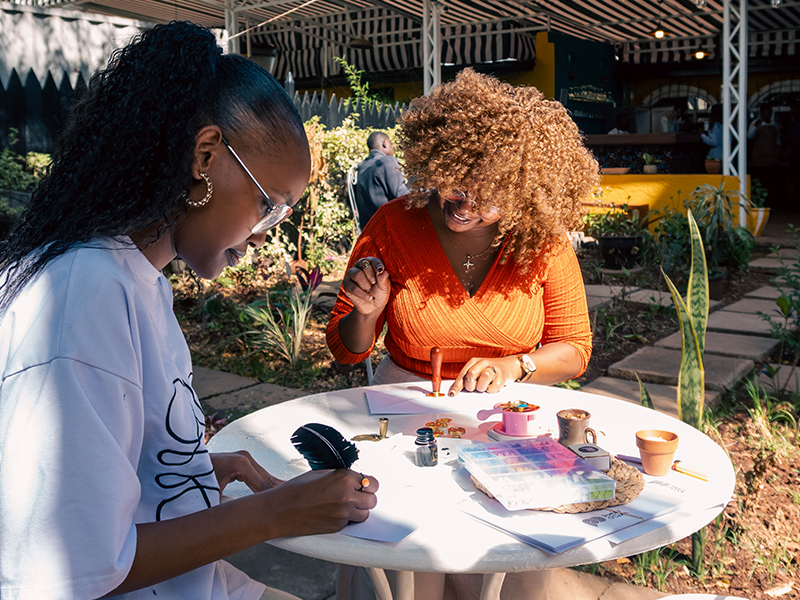
At the Poetry O’Clock table, this difference becomes visible in small, quiet ways. Someone dictates a story slowly, testing each phrase as it’s spoken. The typewriter responds with a steady rhythm, each keystroke leaving an imprint that cannot be undone. When the poem is finished, the page is removed carefully, as though it has become something more than paper.
The recipient often reaches for it with a kind of hesitation. Not uncertainty, exactly, but awareness. They are about to read something that was made for them, in a way that cannot be replicated or forwarded or skimmed. And after they read, there is often a pause. Sometimes they put away the page immediately, holding it close. Sometimes they read it again, more slowly. Sometimes they begin to speak, and then stop, because the words they want are not yet ready. Letters allow for that space, for the unfinished, the unpolished, the felt.
Slowness as a Form of Care
Digital communication has taught us to expect immediacy. A message sent is a message received. A response delayed becomes noticeable, then meaningful in its absence. Letters exist outside of this rhythm. When you send a letter, you accept a kind of uncertainty. You do not know exactly when it will arrive, or what the day will feel like for the person who receives it. You do not know whether it will be opened immediately or set aside for later. You cannot follow up with a quick clarification or correction.
What you can do is trust the moment in which you wrote it. This slowness is not inefficiency. It is a different form of attention. It asks the writer to be present, to consider not only what they want to say, but how it might be held by someone else, at some unknown point in time. In this way, letters become less about exchange and more about offering. They carry with them the conditions in which they were written, the light in the room, the mood of the day, the particular memory that surfaced while choosing one word over another. These details are not visible in the letter itself, but they are felt.
And perhaps this is part of why letters endure. They are not only messages. They are moments, extended across distance.
The Emotional Texture of Receiving
There is also the experience of receiving a letter, which remains difficult to replicate digitally. It begins before the letter is opened. The envelope itself carries information, the handwriting, the weight, the care with which it was sealed. Even before reading, the recipient understands that time has been given to this object. At Poetry O’Clock, when letters are delivered through The Post, this moment is often described in similar ways. A subscriber opens their mailbox to find something unexpected, not a bill, not a notice, but a piece of writing addressed to no one and, somehow, to them. They pause before opening it. That pause matters.
It creates a threshold between the outside world and the interior space of the letter. It allows the reader to step into a different pace, one that is less about consumption and more about encounter. Inside, the language is often simple. A poem. A reflection. A few carefully chosen lines. But the impact rarely comes from complexity. It comes from recognition. A sentence that feels familiar. A feeling that has been difficult to name, now articulated quietly on the page. A reminder that someone, somewhere, has noticed the same thing. Letters do not demand attention. They invite it.
Memory, Kept in Tangible Form
Digital messages are rarely kept. They accumulate, certainly, but they are not often revisited with intention. They exist within systems designed for continuity rather than reflection. Letters, by contrast, tend to be held onto. They are placed in drawers, tucked into books, stored in boxes that are returned to years later. They become part of a personal archive, not because they were meant to last, but because they were felt to be worth keeping.
At events, it is not uncommon for someone to mention a poem they received months or even years earlier. They describe where they were when they read it, how they folded it, where they placed it afterward. In some cases, they carry it with them. This is not about nostalgia. It is about presence extended over time. A letter does not remain meaningful because it is old, but because it continues to resonate. It becomes something a person can return to, not for new information, but for a familiar feeling.
Writing as a Way of Understanding
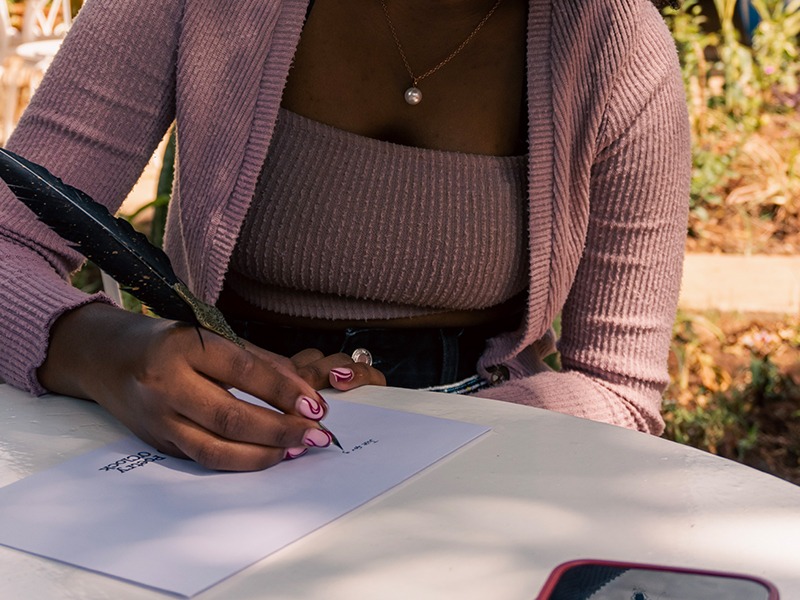
Another reason letters still matter is what they require from the writer. To write a letter is to engage in a kind of self listening. Without the immediacy of a reply, the writer must sit with their own thoughts for longer. They must decide what is essential, what can be left unsaid, what feels true enough to send. This process often reveals more than expected.
At the Poetry O’Clock table, people sometimes begin with a clear idea of what they want to say. But as the conversation unfolds, that idea shifts. A different memory surfaces. A more honest sentence replaces a rehearsed one. The letter becomes not only a message to someone else, but a way of understanding something within themselves. This is part of the quiet work that letters do. They create space for reflection, not as a task, but as a natural part of expression.
The Continued Relevance of Letters
It would be easy to frame letters as something nostalgic, a practice that belongs to another time, maintained now as a kind of aesthetic choice. But this does not fully capture their role. Letters persist not because they are old, but because they meet a need that has not disappeared. In a world where communication is constant, there is still a desire for moments that feel considered. In a landscape of speed and volume, there is still value in slowness and specificity.
Letters offer a different kind of connection, one that is not defined by immediacy, but by intention. They remind us that not all communication needs to be efficient. Some of it can be deliberate. Some of it can take time. And some of it can arrive quietly, carrying more than we expected.
Why Letters Still Matter in a Digital World
To ask why letters still matter is, in some ways, to ask what we are still looking for in how we communicate. Beyond speed, beyond convenience, there is still a desire to feel seen, to be understood in ways that are not rushed or reduced. Letters meet that desire gently.
They do not compete with digital communication. They exist alongside it, offering something different. A pause. A moment of attention. A piece of language that has been held long enough to become meaningful. At Poetry O’Clock, this continues to unfold in small, everyday ways. A poem typed in response to a quiet conversation. A letter opened at the end of a long day. A folded page carried home in a pocket. These are not grand gestures. They are small acts of care. And perhaps that is precisely why they matter.
If you would like to experience this practice for yourself, you can explore The Post by Poetry O’Clock, a monthly literary letter designed to arrive quietly in your space: https://www.poetryoclock.com/the-post
